
Pytheas of Massalia
- Arda Tunca
- Oct 15, 2025
- 7 min read

Updated: Oct 18, 2025
The First Scientist-Explorer
Pytheas of Massalia (fl. late 4th century BCE) stands as one of antiquity’s most enigmatic figures, an explorer, astronomer, and geographer whose reach extended far beyond the intellectual and geographic boundaries of his time.
At a moment when most Greek thinkers conceived of the Earth as a narrow, temperate band of civilization surrounded by impassable extremes, Pytheas undertook a voyage that radically expanded the Greek worldview.
Sailing from the Greek colony of Massalia (modern Marseille) beyond the Pillars of Hercules (Gibraltar) and northward along the Atlantic coasts of Europe, Pytheas claimed to have reached Britain, the North Sea, and possibly even Thule (the northernmost region reached by Pytheas, possibly Iceland or coastal Norway, where he observed the midnight sun), a land six days’ sail from the northernmost isles of Britain.
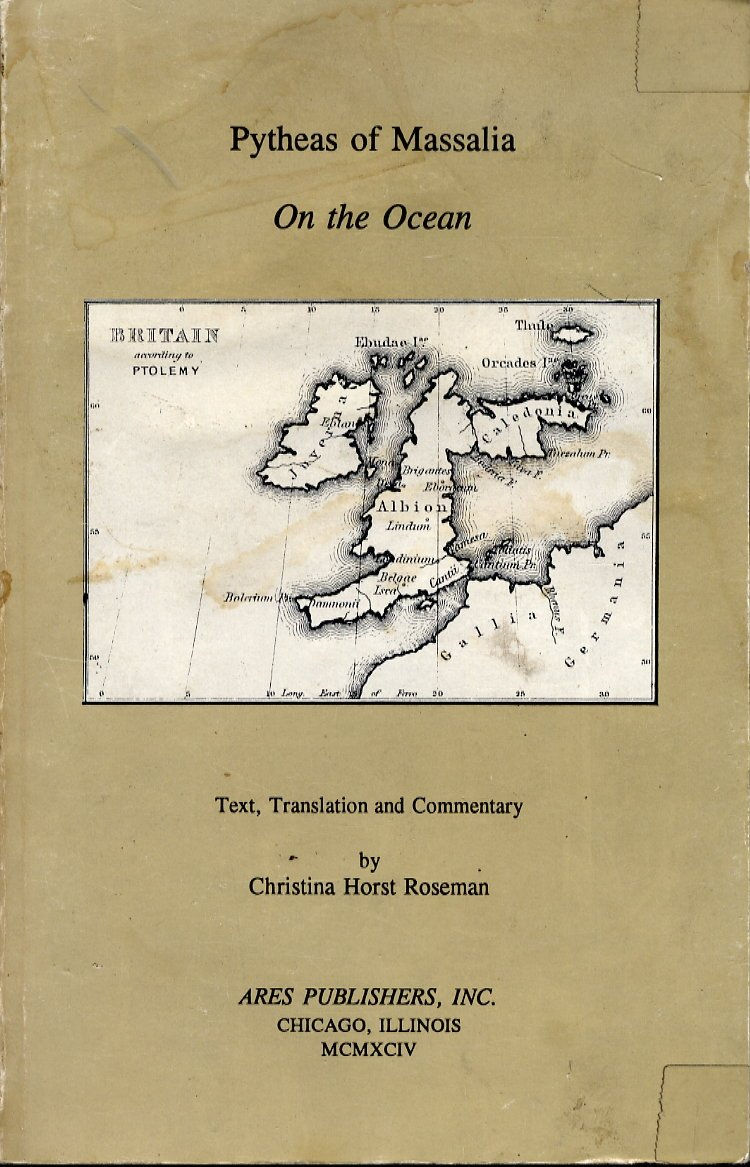
His lost work, On the Ocean (Περὶ τοῦ Ὠκεανοῦ), survives only in fragments quoted or paraphrased by later authors, chiefly Strabo, Pliny the Elder, Diodorus Siculus, and Geminus. From these fragments, modern historians have reconstructed a vision of Pytheas as the first true scientific explorer, one who applied the methods of astronomy and geometry to navigation, geography, and climate.
“With Pytheas, exploration became an empirical science rather than a poetic or mythic act.” — Barry Cunliffe, Facing the Ocean: The Atlantic and Its Peoples (Oxford University Press, 2001, p. 96)
Greek Rationalism and the Spirit of Inquiry
Pytheas’s voyage emerged from the intellectual climate of the late Classical and early Hellenistic world, an era defined by mathematical curiosity and empirical reasoning.
Greek natural philosophy, from Anaximander and Eratosthenes to Aristotle, sought rational explanations for cosmic and terrestrial phenomena. Yet by the mid-4th century BCE, Greek geography remained Mediterranean-centric. The regions beyond Iberia and the Pillars of Hercules were treated as mythic or uninhabitable.
In this context, Pytheas’s journey represented an epistemological rupture. His approach mirrored the rational empiricism of the Ionian tradition, the belief that knowledge of the natural world could only be obtained through direct observation and quantification. This set him apart from earlier “periegetai (περιηγηταί: geographical describers)”, who often compiled second-hand reports without verification.
“He appears to have been the first person to use astronomical observations systematically to determine geographic position.” — Duane W. Roller, Through the Pillars of Herakles: Greco-Roman Exploration of the Atlantic (Routledge, 2006).
Massalia, founded by Phocaean Greeks (Phocaea is modern Foça, located on the Aegean coast of Turkey) around 600 BCE, was a commercial outpost at the interface between the Greek and Celtic worlds. It functioned as both a trading hub and a scientific frontier, where Mediterranean mathematical traditions met northern mercantile networks.
Pytheas’s voyage likely had a dual purpose: to explore the tin and amber routes linking Gaul (roughly modern-day France and surrounding regions) and Britain, and to advance scientific understanding of the northern world.
“Massalia’s peculiar position, Greek by culture, western by geography, produced the perfect conditions for a man like Pytheas.” — J. Oliver Thomson, History of Ancient Geography (Cambridge University Press, 1948, p. 97)
The Voyage: Scope, Methods, and Scientific Breakthroughs
While the precise route remains uncertain, most reconstructions follow a general path:
From Massalia to Gades (Cádiz), passing the Pillars of Hercules.
Northward along the Iberian and Gallic coasts.
Across the Channel to Britain, where he observed agricultural and tidal patterns.
Beyond Britain to the mysterious Thule, described as a land where “the summer sun scarcely sets.”
Possible contact with the Baltic region, known for amber trade.
Return via similar routes.
Though Strabo accused Pytheas of exaggeration, modern geographical analysis of his descriptions of latitude, daylight variation, and tides supports their empirical accuracy.
Pytheas measured the altitude of the sun using a gnomon, a simple astronomical instrument that allowed him to estimate latitude. He reportedly observed that in Thule, the sun remained above the horizon at midnight, a clear reference to the midnight sun, indicating a location near the Arctic Circle (≈66.5° N).
“Pytheas appears to have been the first person to use astronomical observations systematically to determine geographic position.” — Duane W. Roller, Through the Pillars of Herakles (Routledge, 2006, p. 48)
Pliny the Elder explicitly credits Pytheas with recognizing the lunar cause of tides, noting that “he was the first to describe the influence of the moon upon the ocean.” This observation, confirmed centuries later by Newtonian mechanics, illustrates the scientific acumen of Pytheas’s observations.
Pytheas also observed the gradation of climatic zones from the Mediterranean to the polar regions, noting differences in vegetation, agriculture, and human adaptation. His descriptions of British agriculture, where the people “threshed grain in barns because of the lack of sunlight to dry it,” reveal early climatological reasoning.
“His remarks on northern agriculture reveal not hearsay but keen environmental observation.” — Lionel Casson, Travel in the Ancient World (Johns Hopkins University Press, 1994, p. 127)
Beyond physical geography, Pytheas provided ethnographic detail about the Britons and Celts, describing their social organization and trade in tin and amber. These descriptions prefigure the ethnographic methods of later writers such as Tacitus and Caesar, and they remain among the earliest scientific depictions of northern European societies.
Reception and Skepticism in Antiquity
The extraordinary nature of Pytheas’s claims drew sharp criticism from later scholars. Strabo dismissed him as a “liar” and “fabricator,” and Polybius questioned his data on Britain’s size and climate. The skepticism stemmed from Pytheas’s challenge to the Aristotelian conception of a temperate, inhabited world confined to known latitudes.
Ironically, the more accurate his empirical data were, the less credible they seemed within the conceptual frameworks of ancient cosmology.
Although Strabo sought to discredit Pytheas, it is through Strabo’s polemics that much of his testimony survives. Thus, the very texts that attempted to erase Pytheas ensured his partial survival in intellectual history, a paradox of ancient historiography.
“Strabo’s condemnation, paradoxically, immortalized Pytheas.” — Nicholas Purcell, Quarantine, Diseased Geographies, and Cross-Cultural Encounters in the Eighteenth-Century Mediterranean, Journal of Hellenic Studies, Vol. 109 (1989), p. 34
Influence on Later Geographers and Astronomers
A century after Pytheas, Eratosthenes drew upon northern data, possibly derived from Pytheas’s voyage, in calculating the Earth’s circumference (c. 240 BCE). Eratosthenes accepted Pytheas’s observation that Thule lay near the Arctic Circle, using it to establish the northernmost habitable latitude. In doing so, he effectively integrated Pytheas’s empirical findings into the emerging framework of scientific geography.
“Eratosthenes recognized Pytheas not as a fabulist but as a source of reliable data for geodesy.” — Roller, Duane W. Eratosthenes’ Geography. Princeton University Press, 2010.
Later geographers such as Hipparchus and Ptolemy refined the mathematical modeling of the Earth but relied less on firsthand observation. Ptolemy, in particular, rejected Pytheas’s data as inconsistent with his geometric projections. As Berggren and Jones note:
“Ptolemy’s rejection of Pytheas reflects not the weakness of Pytheas’s evidence but the rigidity of the Ptolemaic system.” — J. L. Berggren & A. Jones, Ptolemy’s Geography (Princeton University Press, 2000, p. 78)
In the Middle Ages, Pytheas’s Thule took on mythic dimensions appearing in texts from Isidore of Seville to Dante Alighieri as the symbol of the world’s northern limit.
The Renaissance revival of classical science, however, restored Pytheas’s reputation as a proto-scientific explorer. Humanist scholars such as Gerardus Mercator and Ortelius cited him as an authority for northern latitudes.
“Where the sun, with slowest course, sets beyond Thule…” — Dante Alighieri. Paradiso. In The Divine Comedy: Paradiso, trans. Allen Mandelbaum. New York: Bantam Books, 1986.
Pytheas and the Evolution of Scientific Exploration
Pytheas’s methodological innovations, direct observation, astronomical measurement, climatic correlation, constitute the foundation of geographic empiricism. His approach prefigured the practices of later scientific voyagers such as Captain James Cook, who likewise combined navigation, astronomy, and ethnography in his Pacific expeditions.
In contrast to mythic travelers such as Odysseus or Jason, Pytheas’s journey represented a transformation of exploration into epistemic inquiry. His Thule was not a realm of monsters, but a geographical hypothesis verified through celestial observation. In this sense, Pytheas symbolizes the moment when Greek rationalism met the edge of the world and persisted.
“Pytheas transformed the periphery of the known world into the frontier of science.” — Cunliffe, 2001, p. 143
The North as a Scientific Frontier
Pytheas’s significance lies not merely in the distance he traveled, but in the intellectual distance he traversed. His willingness to measure, to doubt inherited dogma, and to trust observation over authority marks him as one of the earliest exemplars of the scientific method.
His voyage inaugurated the idea that knowledge expands through direct engagement with the world’s physical boundaries. For the Greeks, who defined civilization by proximity to the Mediterranean, Pytheas demonstrated that reason itself had no geographic limit.
“He remains a pioneer in the truest sense: not a man who conquered lands, but one who conquered ignorance.” — Casson, 1994, p. 130
Thule in Renaissance Music and Imagination
The enduring fascination with Pytheas’s Thule found a striking echo in Renaissance music, most vividly in Thomas Weelkes’s madrigal “Thule, the Period of Cosmography” (c. 1600).
Composed at the height of England’s maritime expansion, the work directly invokes the name Thule, the northern limit first recorded by Pytheas, and transforms it into a symbol of human curiosity and extremity.
Weelkes’s text pairs fiery volcanoes with frozen seas, evoking the same natural paradoxes Pytheas described near the edge of the known world. In this sense, the madrigal stands as a rare musical afterlife of Pytheas’s discovery, where empirical geography becomes artistic allegory.
Conclusion
In an age when vast stretches of the Earth were thought to be either uninhabitable or mythological, Pytheas’s decision to sail beyond the Pillars of Hercules (modern-day Gibraltar) into the Atlantic was a radical act of intellectual and physical courage. The ancient Mediterranean worldview was largely confined to temperate zones, and travel into the “outer sea” was considered perilous, both due to navigational uncertainty and cultural fear of the unknown.
“To venture beyond the known world not for conquest or trade alone, but in pursuit of knowledge, was an act of scientific heroism.” — Barry Cunliffe, The Extraordinary Voyage of Pytheas the Greek, Penguin, 2002, p. 12.
By daring to travel into regions where no Greek had verifiably gone before, and by observing, documenting, and theorizing based on what he found, Pytheas challenged the psychological boundaries of his civilization. His bravery was not only nautical but epistemic: he risked his credibility by reporting things that seemed unbelievable to his peers, such as the midnight sun or lunar influence on tides.
“His courage lay not only in facing the dangers of the ocean, but in confronting the disbelief of his peers with scientific truth.” — Duane W. Roller, Through the Pillars of Herakles, Routledge, 2006, p. 64.
Where others told myths, Pytheas told measurable truths, and was attacked for it. That resistance only underscores his audacity to follow evidence.


Comments