
War, Debt, and the Price Level

Wars heighten economic actors’ perception of risk. The conditions created by wars may offer advantages to certain interest groups. For society as a whole, however, they strengthen the desire for economic security. Under such circumstances, savers can be expected to turn to government bonds, which they regard as safe assets that protect their economic interests. Bond prices and yields move in opposite directions. Therefore, purchases by savers raise bond prices but lower bond yields.
Recent developments in global bond markets do not reflect the mechanism described above. Despite the war, government bonds are being sold and bond yields are rising.
The price of Brent crude has exceeded $100 per barrel because of escalating military tensions around both the Strait of Hormuz and the Bab el-Mandeb Strait. The yield on the 10-year U.S. Treasury is close to 5%, while the 30-year Treasury yield stands at around 5.4%. From Japan to Germany and the United Kingdom, government bond yields have reached levels not seen in many years. Markets are concerned that the oil shock will accelerate inflation and that rising interest rates will place increasing pressure on governments’ fiscal positions.

The war is not the sole cause of the bond crisis. It has once again exposed the vulnerability of a global economy burdened by persistently high debt levels.
The war is not the sole cause of the bond crisis. It has once again exposed the vulnerability of a global economy burdened by persistently high debt levels.

By the end of the first quarter of 2026, global debt had reached $353 trillion. This was equivalent to approximately 305% of global GDP. The total includes debt owed by governments, households, financial institutions, and non-financial corporations. The recent increase, however, has been driven to a significant extent by government borrowing in the United States and borrowing by non-financial corporations in China.
In the coming period, rising defense expenditures and the financing needs created by energy security, aging populations, and industrial policies will further increase governments’ funding requirements. The combined annual interest bill on the public debt of OECD countries has already exceeded $2 trillion.

Fiscal Dominance and the Case of Brazil
The developments described above make it necessary to revisit certain economic concepts. Rising bond yields indicate that fiscal pressures are mounting amid high debt, inflation, and concerns about fiscal credibility. They do not, however, demonstrate that fiscal dominance has materialized. In the United States today, it is more accurate to speak not of fiscal dominance itself, but of conditions that increase the risk of fiscal dominance.
Brazil provides a powerful example for explaining fiscal dominance conceptually. The purpose of this article is not to draw a direct comparison between the United States and Brazil. Brazil’s historical circumstances were very different from those confronting the United States today. The Brazilian case is important as a “boundary case” that makes the conflict between monetary and fiscal policy particularly clear. In other words, it provides a useful case study for understanding the concept of fiscal dominance.
The U.S. dollar is a reserve currency, and U.S. debt is denominated in dollars. The U.S. Treasury market is the largest and most liquid bond market in the world. A Federal Reserve rate increase does not directly produce a currency crisis or increase the burden of foreign-currency debt, as it could in Brazil. Nor, at least for now, has the Fed been forced to subordinate its fight against inflation to the objective of reducing the Treasury’s borrowing costs.
Brazil had foreign-currency-linked debt, shallower financial markets, high exchange-rate pass-through, and a significant risk of default. In Brazil, the crisis moved rapidly through the exchange rate, capital outflows, and the default risk premium. In the United States, the pressure may instead appear over a longer period in the form of persistently high real interest rates, a rising term premium, falling bond prices, and inflation that erodes the real value of the debt.
Brazil makes the underlying mechanism easier to see. If fiscal policy does not support monetary tightening with future primary surpluses, a rate increase may cease to be a remedy and instead become part of the debt and inflation problem.
Japan’s dilemma over the yen and government bonds represents another form of the same debate. While a weak yen turns the oil shock into imported inflation, rate increases by the Bank of Japan make it more costly to finance the country’s enormous public debt. Foreign-exchange intervention and international liquidity arrangements may buy the yen some time, but they cannot eliminate the growing tension between monetary policy and debt sustainability.
It is important to distinguish among three stages on the path toward fiscal dominance:
Fiscal vulnerability: The budget becomes sensitive to changes in interest rates because of the size and maturity structure of public debt and the level of interest expenditure. At this stage, monetary policy is not yet subordinate to fiscal policy.
Risk of fiscal dominance: Markets begin to expect that fiscal policy will fail to produce the primary balance required to stabilize the debt and that the central bank will eventually be forced to accommodate the government’s financing needs.
Fiscal dominance: A regime in which the fiscal authority fails to adjust taxes and expenditures in a manner that stabilizes public debt, forcing monetary policy to accommodate the government’s financing needs. Such accommodation may take the form of higher inflation, monetary financing, bond purchases, the suppression of bond yields, or keeping interest rates below the level required for price stability.
Under this classification, the United States is currently in the first stage. Concerns about the second stage, however, are growing.
With this conceptual framework in place, we can now turn to the Brazilian case, which is particularly useful for understanding the mechanisms involved.
In a regime characterized by active monetary policy and passive fiscal policy, the central bank uses interest rates to fight inflation without subordinating its decisions to the government’s financing needs. The fiscal authority, in turn, adjusts the primary balance as necessary to stabilize public debt.
Thomas Sargent and Neil Wallace argue in their 1981 study, “Some Unpleasant Monetarist Arithmetic,” that if fiscal policy continues to generate persistent deficits, monetary tightening today may increase debt-servicing costs and ultimately necessitate greater monetary expansion in the future. Under such a regime, tight monetary policy today may increase inflation tomorrow.
Eduardo Loyo’s 1999 study seeks to explain Brazilian inflation in the late 1970s and early 1980s through the “tight money paradox.”
A significant share of Brazil’s public debt was short-term and sensitive to interest rates. When the central bank raised interest rates, the government’s interest payments to bondholders increased rapidly. If the government did not offset this additional cost through higher taxes or lower spending, it had to borrow more. As a result, both nominal government liabilities and the interest income transferred to the private sector grew. In Loyo’s model, because this increase was not matched by sufficient fiscal backing, it could fuel aggregate demand and inflation.
When the central bank responded to inflation by raising interest rates again, the government’s interest expenditure rose once more, creating a self-reinforcing cycle between borrowing and inflation.
Two distinct effects must be separated here. The first is the increase in the government’s interest expenditure caused by higher interest rates. The speed of this effect depends on the maturity and interest-rate structure of public debt. If the debt is short-term or carries a floating interest rate, the effect reaches the budget more quickly. If it is long-term and carries a fixed rate, the effect emerges gradually as the bonds are rolled over. According to the U.S. Congressional Budget Office, all else being equal, higher interest rates increase the federal government’s net interest expenditure.
The second effect concerns whether the government’s additional interest payments increase private-sector consumption. By transferring income from borrowers to creditors, an increase in interest rates affects households differently depending on their balance sheets, indebtedness, and propensity to consume. If the recipients of interest income have a low propensity to spend, while borrowers have a strong tendency to reduce their spending, aggregate consumption may not increase. The effect of higher interest payments on aggregate demand therefore depends on who receives the additional income.
Loyo’s model of Brazil rests on a much more specific set of conditions. A significant share of public debt is short-term and sensitive to changes in interest rates. An increase in the central bank’s policy rate rapidly raises the government’s interest payments. Fiscal policy does not offset this increase through higher taxes or lower spending, and the additional payments are financed through further borrowing. If the private sector also believes that these new government liabilities will not return to it later in the form of higher taxes, a net wealth effect may arise. Under such conditions, higher interest payments may increase consumption and prices. If the central bank responds to rising inflation by raising interest rates again, it may reinforce the cycle among interest expenditure, public debt, and inflation.
This mechanism does not mean that high interest rates generally cause inflation. For such an outcome to arise, fiscal policy must fail to offset the budgetary effect of higher interest rates, the additional interest income must be spent, and the resulting increase in expenditure must outweigh the contractionary effect of higher interest rates on credit and investment. When these conditions do not occur together, the usual effect of higher interest rates is to weaken aggregate demand and inflation.
It must therefore be emphasized that, within the mechanism described above, high interest rates do not cause inflation under all circumstances. Such an outcome can occur only under the very specific condition that the government is unable to offset the additional budgetary burden created by higher interest rates through taxation or spending policy.
In the United States, high interest rates are increasing the government’s interest expenditure, which in turn is adding to its borrowing requirements. This creates some of the preconditions for the mechanism examined by Loyo. It cannot yet be claimed, however, that higher interest payments have produced a powerful wealth and consumption effect, that this effect has outweighed the contractionary impact of high interest rates on aggregate demand, or that the Fed has become subordinate to the government’s financing needs. It is therefore more accurate to speak not of an already established “high interest–high inflation” cycle, but of fiscal conditions that are increasing the risk of such a cycle emerging.
Brazil’s 2002 crisis involved a different transmission mechanism. According to Olivier Blanchard’s analysis, high public debt, the large share of foreign-currency-linked debt, and a decline in global risk appetite meant that higher interest rates increased the probability of default instead of making Brazilian bonds more attractive. In Blanchard’s analysis, the rising risk premium could accelerate capital outflows and the depreciation of the real, while the weaker exchange rate could intensify inflationary pressure.
The restoration of confidence in Brazil depended not only on high interest rates, but also on the Lula administration’s decision to raise its 2003 primary surplus target to 4.25% of GDP, its commitment to maintain fiscal discipline over the medium term, and its steps toward pension reform. These policies were followed by declining risk premiums and an appreciation of the real. The decisive factor in persuading markets was not higher interest rates alone, but a political commitment to ensure that future fiscal balances would support the public debt.
The Fiscal Theory of the Price Level
One of the theoretical connections that can be drawn between the Brazilian case and current developments emerges from the Fiscal Theory of the Price Level (FTPL). Developed in the work of Leeper, Sims, and Woodford, and later treated systematically by Cochrane, this approach regards government debt as a financial liability that must be backed by future government revenues.
In simplified terms, the current purchasing power of the money in circulation and fixed-value nominal government debt must equal the present value of the primary budget surpluses the government is expected to generate in the future. A primary surplus is calculated by subtracting government expenditure excluding interest payments from government revenue. The present value of future surpluses is the sum of those surpluses discounted to the present, taking time and risk into account.
Under monetary dominance, the central bank seeks to maintain price stability. Fiscal policy, in turn, seeks to establish the future primary balances needed to keep public debt sustainable.
Under fiscal dominance, by contrast, the government does not commit to adjusting its taxation and spending policies in response to the level of public debt.
The mechanism can be illustrated with a simple example. Suppose that the initial price level is 1. The government has $100 in nominal liabilities, while the present real value of expected future primary surpluses corresponds to only $80 in purchasing power at initial prices. If the government will not raise taxes, reduce spending, or default on its debt, the full $100 liability is not backed by the available fiscal resources.
If the private sector regards these liabilities not as debt that will be matched by future taxes, but as an increase in net wealth, it will seek to increase consumption. Individual investors can sell their bonds, but the private sector as a whole cannot eliminate the liabilities issued by the government. When total desired spending exceeds the economy’s productive capacity, the price level rises.
Suppose the price level rises from 1 to 1.25. The real value of the $100 nominal liability then falls to 80: 100/1.25=80
The government’s nominal debt is still $100. What has changed is the purchasing power of that debt. The 25% increase in the price level has brought the real value of the debt into line with the present value of future primary surpluses, which equals 80 units. In the simplified FTPL mechanism, inflation reduces the real value of nominal government liabilities that lack sufficient fiscal backing.
During the Second World War and in its aftermath, the Fed held government bond yields at low levels to facilitate the financing of public debt. After price controls were lifted, inflation rose while nominal interest rates remained constrained, producing negative real interest rates. Alongside economic growth and favorable budget balances, inflation therefore contributed to reducing both the real value of public debt and its ratio to national income. This historical policy was not FTPL. Financial repression describes the instruments that were used, whereas FTPL is a theoretical framework explaining how the price level is determined under particular combinations of fiscal and monetary policy.
What matters from the perspective of FTPL is an increase in net government liabilities that is not backed by future fiscal revenues. The Treasury’s replacement of a maturing bond with a newly issued bond does not, by itself, create new fiscal wealth. Nor must the price level rise if debt-financed spending will be matched by higher primary surpluses in the future. Economic growth contributes to fiscal backing only if it strengthens future budget surpluses by increasing tax revenues more than primary expenditure.
The maturity structure of public debt affects how the adjustment takes place. In simple models in which all debt is short-term and fixed in nominal value, the price level can rise rapidly and reduce the real value of the debt. In economies with long-term bonds, by contrast, deteriorating fiscal expectations can lower the market prices of outstanding bonds and spread the inflationary adjustment over time.
A decline in bond prices means an increase in bond yields. Not every increase in yields, however, indicates that the FTPL mechanism is at work. Yields may also rise because of expectations about central bank policy, oil prices, bond supply, or general uncertainty. In open economies, depreciation of the national currency may accompany the process, but exchange-rate depreciation is not a necessary implication of FTPL.
FTPL does not require the central bank to print money or purchase government bonds directly for inflation to arise. Fixed-value nominal government bonds that lack sufficient fiscal backing are also part of the total government liabilities held by the private sector. Inflationary pressure generated by fiscal policy can therefore begin even without an expansion of the central bank’s balance sheet. This does not mean that monetary policy is irrelevant. Interest-rate policy continues to influence the value of public debt, the government’s interest expenditure, and the path of inflation over time.
At the center of the debate over FTPL lies the question of whether the government’s intertemporal budget relationship determines the price level or whether the government adjusts taxes and spending in response to the existing price level and debt stock. Critics of the theory argue that the required adjustment may occur through fiscal measures, default, or changes in bond prices rather than through inflation. FTPL should therefore be used not as a proven explanation of the current bond sell-off, but as a framework for examining the consequences that may arise when fiscal and monetary policy become inconsistent with one another.
While the oil shock raises inflation expectations and increases the likelihood of central bank rate hikes, governments may weaken their fiscal credibility by expanding war expenditures, energy subsidies, or cash transfers without backing them with higher future revenues. Such developments alone, however, do not prove that fiscal dominance has emerged or that the FTPL mechanism is at work. A more limited and defensible conclusion can be drawn from the theory: if the fiscal authority increases nominal government liabilities without generating the future primary surpluses required to back them, the central bank cannot guarantee price stability on its own.
Washington’s Contradiction
The situation in the United States does not yet constitute a full-fledged regime of fiscal dominance. Pressure in that direction, however, is clearly increasing.
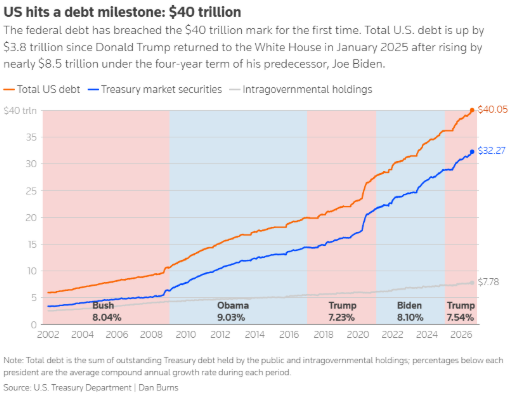
On one side stand federal debt exceeding $40 trillion, a budget deficit of approximately $2 trillion in the first eleven months of the 2026 fiscal year, growing defense expenditures, and high interest costs. On the other side, President Donald Trump has promised to distribute a $5,000 “dividend” to every American adult if Republicans retain control of Congress in the midterm elections. Such a program would cost an estimated $1.2–$1.3 trillion.
The U.S. Treasury conducted a bond buyback of up to $6 billion under a program intended to support market functioning in older and relatively less liquid securities. The Treasury purchased only $5.2 billion of the $10.5 billion in securities tendered. Given the roughly $32 trillion size of the market, the operation was extremely limited in scale.

A bond buyback does not, by itself, permanently reduce net public debt. Its primary purpose is to manage the maturity structure of the debt and the distribution of liquidity across the market. The two operations do not serve the same economic function. However, the difference in scale between them reveals a major inconsistency in Washington’s fiscal outlook. While the Treasury is trying to improve market liquidity through transactions worth a few billion dollars, Trump is promising a new fiscal expansion that could exceed $1 trillion. Has the potential inflationary impact of this fiscal expansion been considered?

When such current developments are interpreted through the lens of FTPL, one question should immediately arise: What size primary surplus is targeted in return for these new liabilities, and over what future horizon?
If this question cannot be answered satisfactorily, or if no fiscal plan exists, investors will demand higher yields as compensation for the risks of higher inflation and greater bond issuance. Higher bond yields then increase interest expenditures. Rising interest expenditures widen the budget deficit. A larger deficit requires more bond issuance. Greater supply and deteriorating fiscal credibility push the term premium even higher. In other words, a negative spiral emerges.
Because the entire debt stock is not repriced at new interest rates all at once, this cycle unfolds over time. The average maturity of the debt and the composition of investors matter. However, as the debt is rolled over, higher market interest rates gradually feed into the budget.
When Does an Oil Shock Become a Fiscal-Inflationary Problem?
An increase in oil prices initially constitutes a supply shock and a relative-price shock. If society accepts the real income loss caused by higher energy import costs, the impact may diminish over time.
However, if governments attempt to offset this income loss entirely through checks, energy subsidies, tax cuts, or debt-financed support, the real loss is converted into nominal public liabilities. If military expenditures are also rising at the same time, the oil shock may develop from a temporary price movement into a persistent fiscal-inflationary problem.
Central banks are expected to eliminate, solely through interest rates, the inflation created by political and military decisions. Yet central banks’ policy tools are limited in the face of effects this broad. As interest rates rise, demand weakens. But the government’s interest expenditures and interest payments to the private sector also increase. If fiscal policy does not offset this effect, monetary policy may increasingly worsen debt dynamics even as it contracts the economy.
Conclusion
The significance of today’s global bond sell-off is that markets are questioning how governments will finance the costs of war, defense, social transfers, and energy.
Central banks can raise policy rates. Treasuries can support market liquidity through bond buybacks. Countries can intervene in foreign exchange markets. But none of these measures provides any information about future primary surpluses.
How many basis points the Fed, the ECB, or the Bank of Japan raises interest rates matters for the economic consequences. Monetary policy, however, cannot by itself compensate for the absence of a credible fiscal framework.
The central issue today is whether governments can establish a credible fiscal framework to support the nominal liabilities they create. If they cannot, adjustments will continue through bond prices, term premiums, exchange rates, and the price level. The fiscal answer that politics fails to provide will appear in markets as higher borrowing costs and in society as lower purchasing power.


Comments