
The Annales School and the Remaking of Historical Knowledge

A declaration of war may have a precise date. However, the capacity to fight it is formed over decades or centuries through a variety of factors. A commercial crisis may erupt suddenly, but the structure of trade, credit, property, and social hierarchy that makes the crisis possible may have a much longer history.
The Annales tradition introduces a valuable perspective on history. It changed the meaning of historical explanation. The history of any discipline should examine the temporalities within which human societies live. The rapid time of events, the medium-term time of economic and demographic movements, and the slow time of institutions, environments, and inherited ways of life are embedded in the genes of history.
The Roots of the School
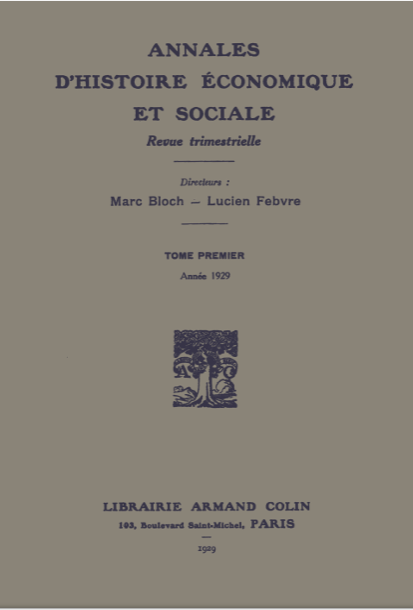
The movement took its name from Annales D’histoire Économique Et Sociale, founded in Strasbourg in 1929 by Marc Bloch and Lucien Febvre. Both opposed the dominant form of academic history in France, which concentrated heavily on states, diplomacy, political leaders, and documentary evidence produced by official institutions.
Bloch and Febvre wanted history to enter into sustained conversation with geography, sociology, economics, anthropology, psychology, and linguistics. They were influenced by the geographical work of Paul Vidal de la Blache and by the sociology of Émile Durkheim. Their ambition was a problem-oriented history capable of drawing on any discipline that helped explain change over time.
In The Royal Touch, Marc Bloch examined the belief that the kings of France and England could cure scrofula by touching the sick. For Bloch, the belief revealed how monarchy was socially imagined and sustained by collective expectations. In Feudal Society, he treated feudalism as an interconnected social order involving land, protection, kinship, lordship, and warfare.
Febvre’s studies of geography, religion, and early modern thought asked what people in a particular historical world could plausibly think and express. In The Problem of Unbelief in the Sixteenth Century, he argued against projecting modern categories of atheism backward onto François Rabelais. Rabelais’s thought operated through a historically formed language, intellectual equipment, and social environment. The historian’s task was to reconstruct the conditions that made some forms of thought possible and others difficult or unavailable.
This principle remains one of the strongest defenses against anachronism. The past cannot be understood simply by assigning present-day identities and categories to people who lived in different conceptual worlds.
Fernand Braudel and the Plurality of Historical Time
Fernand Braudel’s outstanding and monumental The Mediterranean and the Mediterranean World in the Age of Philip II was nominally concerned with the sixteenth century and the reign of Philip II. Braudel began with mountains, seas, plains, climates, routes, harvests, settlements, and patterns of movement. Political history was placed within a much larger history of the Mediterranean as a space of material and social interaction.

Braudel distinguished among three broad levels of historical time. The first was the short time of events: battles, diplomatic decisions, royal successions, rebellions, and political crises. The second was the time of conjunctures: price movements, commercial cycles, demographic changes, and shifts that unfolded across time. The third was the longue durée: slowly changing structures such as geography, systems of cultivation, trade routes, urban networks, institutions, and enduring social practices.
These concepts helped illustrate that there were simultaneous dimensions of the same historical reality. A grain shortage could be an immediate event, part of a longer price movement, and an expression of an agricultural and transport system formed over centuries. The explanatory task was to show how these temporalities interacted.
Much economic analysis operates within time that is either abstract or compressed. It is, therefore, static most of the time. Institutions, preferences, technologies, and property relations can appear as given conditions surrounding a model. The longue durée asks how those supposedly given conditions were historically produced, how long they persisted, and under what pressures they changed. From this standpoint, an economy is never simply a mechanism for allocating scarce resources or reaching so-called multiple market equilibria. Economics is a historically formed organization of material life.
Braudel developed his argument further in Civilization and Capitalism, 15th–18th Century. He distinguished among material life, ordinary market exchange, and capitalism. Material life consisted of the routines of production and consumption that often remained partly outside formal markets. Market exchange involved more visible and competitive transactions. The capitalist sphere consisted of powerful merchants and financiers who could use information, credit, political privilege, monopoly, and long-distance networks to escape the conditions of ordinary competition.

This distinction challenges the simple identification of capitalism with free markets. In Braudel’s account, capitalism flourished not merely through exchange but through asymmetries of power and privileged access. His analysis converges at certain points with historical political economy and with Karl Polanyi’s argument that markets are instituted through social and political arrangements rather than existing outside them. The two approaches are not identical, but both reject the treatment of the economy as an autonomous sphere governed by timeless laws.
From Structures to Mentalities and Everyday Life
Annales was always less unified than the word “school” suggests. Later historians expanded the field in several directions. Jacques Le Goff and Georges Duby explored medieval society, culture, and symbolic systems. Emmanuel Le Roy Ladurie combined demographic, climatic, and social history before turning to the study of a village community in Montaillou. Philippe Ariès examined changing attitudes toward childhood and death. These works helped make family life, food, sexuality, literacy, ritual, fear, memory, and the experience of ordinary people subjects of historical inquiry.
The concept of mentalités became prominent. It referred to shared dispositions, categories, habits, and assumptions through which groups perceived the world. The concept included attitudes toward time, death, the body, authority, childhood, religion, and the natural world.
This turn produced an enormous expansion of historical subject matter. It encouraged historians to use sources long considered peripheral, some of which were parish registers, judicial records, wills, tax documents, maps, household inventories, prices, images, oral traditions, climatic evidence, and archaeological findings. The archive ceased to mean only the official papers of states.
Peasants, artisans, women, families, religious minorities, and local communities entered narratives previously dominated by sovereigns and diplomats. History became more democratic in its subject matter.
A Different Conception of Historical Causation
One of the most important contributions of Annales lies in its conception of causation. Conventional narratives usually explain an outcome by identifying the decision that immediately preceded it. Annales historians treated such explanations as incomplete due to the fact that the range of available decisions was already structured by material and social conditions.
Political leaders act within the boundaries of fiscal systems, roads, ships, administrative capacities, inherited conflicts, available concepts, and unequal social relations that they did not freely choose. Historical explanation must connect intention to capacity and immediate action to accumulated conditions.
This perspective is particularly valuable for economic history. Prices cannot be separated from harvests, transport, monetary institutions, bargaining power, and social hierarchy. Trade routes cannot be explained by comparative costs alone. They depend on naval force, legal privilege, credit networks, imperial organization, and the physical character of ports and seas as well. Labor cannot be reduced to a factor of production when its reproduction depends on households, gender relations, health, custom, and political authority.
Annales historians did not merely assemble historical figures on prices, wages, harvests, and trade. They examined the institutions and social relations behind those figures. A market in a medieval town, for instance, could not simply be treated as an earlier version of a modern competitive market. Nor could capitalism be assumed to mean only the exchange of goods and services in the market. Categories such as market, property, labor, and capitalism had to be investigated historically rather than imposed unchanged upon every period.
The Criticisms
The achievement of the Annales school generated some of its most serious weaknesses.
The first criticism concerns structural determinism. J. H. Hexter argued that Braudel’s different explanatory levels did not always form a coherent causal account. The vastness of the work could produce description without clearly showing how its parts explained one another. Structures were visible everywhere, but the precise mechanisms connecting geography, conjuncture, and event were not always demonstrated.
This criticism does not invalidate the longue durée. If slow structures explain too much, transformation becomes difficult to explain. Revolutions, wars, institutional breakdowns, technological changes, and political decisions can alter the conditions under which later generations live. An approach designed to reveal continuity may systematically underestimate rupture.
The second criticism is the marginalization of politics. Early Annales polemics often treated political and diplomatic history as superficial “event history.” Yet, states, law, organized violence, ideology, and political conflict cannot always be derived from deeper social or economic structures. They possess causal force of their own. A parliamentary decision, military defeat, constitutional struggle, or colonial decree may redistribute property, remake institutions, and redirect economic development. Lawrence Stone’s defense of narrative history was partly a reaction against structural approaches that had weakened the role of conscious action, political conflict, and contingency.
Political events become intelligible through structures. Yet, structures are also reproduced or transformed through political action. Annales was strongest when it revealed this interaction. On the other hand, Annales was weakest when it established a hierarchy in which events were merely foam on the surface of a deeper sea.
The third criticism concerns human agency and experience. Quantitative series, demographic patterns, and collective categories can reveal conditions invisible in elite documents. Historians such as Carlo Ginzburg used an exceptionally small scale not to return to traditional biography but to show how individuals negotiated, interpreted, and sometimes resisted the cultural structures surrounding them.
The fourth criticism concerns mentalités. The concept drew attention to tacit beliefs and shared cultural frameworks. However, its boundaries were often unclear. Whose mentality was being described? An entire society, a class, a village, an occupational group, men, women, literate elites, or those whose lives survive only indirectly in the archive? Treating a society as possessing a common mentality could conceal conflict, difference, and unequal power.
The linguistic and cultural turns sharpened this objection. Language helps constitute identities, interests, and fields of action. Roger Chartier called for closer attention to representation, appropriation, and the different ways texts and practices acquire meaning among different groups. From this standpoint, some works on the history of mentalities moved too easily from scattered evidence to claims about a collective mind.
The fifth criticism is the limited treatment of gender and colonial power in much canonical Annales writing. The expansion toward everyday life created space for the history of women and the family. Yet, women were not always analyzed as actors situated within systems of gendered power. Feminist historians showed that households, reproduction, labor, law, and political membership were structured by gender rather than merely belonging to the neutral domain of social life.
Similarly, the Annales emphasis on trade routes, ports, prices, and the movement of goods could push the coercive foundations of commerce into the background. Braudel’s concern with long-term structures and circulation sometimes gave less explanatory weight to conquest, forced labor, colonial rule, and the unequal distribution of commercial power. Later historians placed these relations closer to the center of Mediterranean and global history.
Finally, critics have questioned whether Annales remained a coherent school at all. By the late twentieth century its practitioners were working on such varied subjects, with such different methods, that unity became difficult to identify. François Dosse described the fragmentation of the tradition after Braudel, while others saw this plurality as evidence of intellectual vitality. The Annales school survived. However, it increasingly referred to a heritage of questions and methods rather than a common doctrine.
What Remains of Annales?
The Annales School did not provide a complete theory of history. Yet, it made it impossible to regard political chronology as sufficient historical explanation.
Environmental history, historical demography, the history of everyday life, global history, the study of emotions, material culture, food, climate, family, and collective memory operate on the terrain that Annales helped open. Interdisciplinary history and the use of nontraditional sources have become normal parts of the discipline.
The Annales inheritance is most useful when treated as a method of questioning rather than a fixed model. What moves quickly, and what changes slowly? Which structures make an event possible? How do political decisions reshape those structures? What material conditions sustain a system of ideas? Which groups disappear when evidence is aggregated? Whose experience is concealed by a claim about a collective mentality? At what scale does a causal relationship become visible?
These questions matter for economics as well. Economic life unfolds across different historical times. A financial panic may last days, an inflationary regime years, a technological system decades, and a structure of property or ecological dependence centuries. None can be adequately explained by examining only one timescale. Nor can markets be detached from the institutions, political power, social reproduction, and material environments that allow them to exist.
The strongest lesson of Annales is that an event is never only an event. It is a point at which multiple histories (political, economic, social, cultural, and environmental) temporarily become visible. The task of the historian is to recover those histories without allowing structure to erase action, or action to conceal the structures that give it meaning.
I became acquainted with the Annales school in the early 1990s, and since then, I have been heavily influenced by it in how I interpret economics through the lens of accumulated history and structures. I am delighted to have had the chance to read Bloch and Braudel in particular in the 1990s.


Comments