
A Three-Thousand-Year History of Identity: Greek, Hellene, and Rum

Explaining historical identities through the values of the present can lead to misleading judgments. The Turkish terms Yunan and Rum, the name Hellene, and the English designation Greek are sometimes treated as interchangeable as a result of such judgments. Yet each of these words bears the traces of historical relationships that emerged during different periods in the Aegean, Anatolia, North Africa, and the Eastern Mediterranean.
In Modern Greek, a Greek calls himself Έλληνας (Ellinas), while Greeks collectively call themselves Έλληνες (Ellines) and their country Ελλάδα (Ellada). These words are continuations of the ancient names Hellēn, Hellenes, and Hellas. The same people are called Greeks in English, Grecs in French, and Greci in Italian.
In Turkish, another word exists alongside Yunan: Rum. Rum passed into Ottoman usage from the Eastern Roman name Rhomaioi. During the Ottoman period, the term was used particularly in connection with Orthodox churches and communities that carried the Roman legacy. The scope of the word’s use changed from one period to another. However, it did not fully coincide with the word “Greek” in its modern sense.
The Turkish word Yunan originates from the Ionians. Rum originates from Rome. Greek in Western languages derives from the Latin word Graecus. The name Hellene, which modern Greeks use for themselves, emerged in antiquity as the name of a small community and developed into the name of a broader common identity.
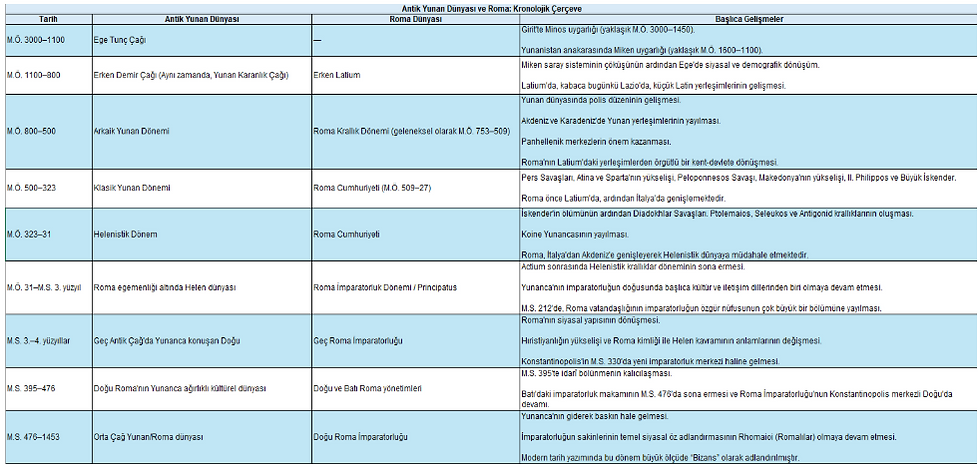
The history of these words tells us how identities formed, expanded, and became established by accumulating in layers upon one another across the Aegean, Anatolia, North Africa, and the Eastern Mediterranean over approximately three thousand years. At the beginning of this long history, there was no single Greek identity in the modern sense.
In Homer’s Iliad, probably composed in the eighth century BCE, no common name of Hellene was used for all the communities fighting against Troy. Homer called these communities Achaioi, Danaoi, and Argeioi, in other words, Achaeans, Danaans, and Argives. Although the name Hellenes appears in the Iliad, it did not signify a common identity encompassing all these communities. The name was associated primarily with a particular community in the area around Phthia, ruled by Achilles. Approximately four centuries later, Thucydides discussed precisely this terminological problem. Similarly, Hellas was not yet the name of the entire Greek geographical area, as it would be in later periods.
During the early centuries of the first millennium BCE, there were various communities, such as the Ionians, Aeolians, Dorians, and Achaeans, that we now regard as elements of the ancient Greek world. These communities differed from one another in their Greek dialects, their distinctive accounts of origins and ancestry, and their regional traditions. At that time, it is difficult to speak of an established common Hellenic identity above these communities in the modern sense.
While the Ionian world extended from Attica to the Aegean islands and cities such as Miletus, Ephesus, and Priene in western Anatolia, Dorian identity was strong in a substantial part of the Peloponnese, on Crete, and in the southeastern Aegean. Aeolian communities, meanwhile, were associated with Thessaly, Boeotia, Lesbos, and the northwestern coasts of Anatolia.
From the Ionians to the Hellenes
There was no state that united these communities into a single political society above their regional affiliations. Within the polis system that developed from the eighth and seventh centuries BCE onward, Athens, Sparta, Corinth, Thebes, Miletus, and other cities were independent political communities. A person’s identity was shaped by the city in which he was born, his regional affiliation, dialect, religion, and account of ancestry. Someone from Miletus could be both Milesian and Ionian, while someone from Sparta could be both Spartan and Dorian. All these communities are now classified as part of the ancient Greek world. However, the broader Hellenic identity that encompassed them was not an identity that had been defined from the outset and remained unchanged. Without eliminating local and regional affiliations, this identity developed over time as a broader sense of common belonging above them.
The history of the Turkish word Yunan also emerged from this complex world. In the mid-sixth century BCE, the Achaemenid Empire reached western Anatolia when the Persian king Cyrus II defeated the Lydian king Croesus. Following the end of Lydian rule around 547/546 BCE, the Greek cities along the coast came under Persian rule. The Ionians constituted a significant proportion of the communities encountered by the Persians. The Old Persian name Yaunā was connected to the Greek Iōnes (Ionians). In Persian usage, the scope of the name expanded over time and came to refer not only to the inhabitants of Ionia but also to different Greek communities.
Viewed from the East, the name of one Greek community became the name of the wider Greek world. This usage continued to live on in Iranian culture. It assumed the forms Yūnān in Arabic and Yunan in Turkish. The name Yunan used in Turkish today therefore derives not from the name Hellēn, which modern Greeks use for themselves, but from the name of the ancient Ionians. In a sense, Turkish carries the memory of the contact that the Persian Empire established in western Anatolia two and a half thousand years ago. While the Persians knew this world to their west by the name of the Ionians, the same communities gave themselves another common name: Hellene.
The great settlement movements undertaken by Greek communities across the Mediterranean and Black Sea between the eighth and sixth centuries BCE played an important role in the spread of the name Hellene. Cities and trade networks extending from southern Italy and Sicily to North Africa, and from the Sea of Marmara to the shores of the Black Sea, made the different communities of the Aegean parts of a broad sphere of circulation. Along with geographical expansion, the networks connecting distant Greek settlements contributed to the formation of a common Greek world.
Sacred centers such as Olympia and Delphi, Panhellenic festivals, gods, heroic narratives, and the dissemination of the Homeric epics created a common cultural foundation among politically independent communities. The significance of the games at Olympia, traditionally dated to 776 BCE, was that people from different cities regarded themselves as members of a broader religious and cultural world. During this process, the name Hellene moved beyond its narrow meaning and became the common name of this world.
The Persian Wars in the early fifth century BCE gave the matter a new dimension. After the Ionian Revolt, which began in 499 BCE, was suppressed with the fall of Miletus in 494 BCE, the conflict moved west of the Aegean. The Battle of Marathon in 490 BCE was followed by Thermopylae and Salamis in 480 BCE and Plataea in 479 BCE. The fact that some Greek poleis fought together against the Persian Empire strengthened the emerging Hellenic sense of common identity.
The concept of “to Hellenikon,” used by Herodotus in the second half of the fifth century BCE, is evidence of this transformation. In the Histories, common blood, common language, common temples and sacrifices to the gods, and common customs are listed among the elements binding the Hellenes together. Over time, the name Hellene acquired a meaning different from its limited use in Homer.
In the Peloponnesian War, which began in 431 BCE and continued until 404 BCE, the two great blocs led by Athens and Sparta virtually exhausted one another. The concept of a common Hellenic identity could not create political unity. An Athenian Ionian and a Spartan Dorian could regard themselves as parts of the Hellenic world while still fighting one another. Ancient Hellenic identity was not a single national identity that eliminated polis and regional affiliations. It expressed a broader cultural affiliation layered over them.
This structure began to change with the rise of Macedonia in the second half of the fourth century BCE. The defeat of the Athenian and Theban forces by Philip II at Chaeronea in 338 BCE largely brought the independent balance of power among the Greek poleis to an end. After Philip II was assassinated in 336 BCE, his son Alexander the Great crossed the Hellespont (the Dardanelles) in 334 BCE and attacked the Persian Empire. He defeated Darius III at Issus in 333 BCE, near present-day Erzin, Hatay, and at Gaugamela in 331 BCE, in the Erbil–Mosul region of present-day northern Iraq. When Alexander died in Babylon in 323 BCE, the territory under his rule extended from Egypt to Mesopotamia and Iran, and from there into Central Asia.
The Birth of the Hellenistic World
The Hellenistic period, which began with Alexander’s death in 323 BCE, marked the beginning of one of the greatest transformations in the history of Hellenic identity. Alexander left neither an adult heir nor a political order that would determine the empire’s future. His generals and the officials in his immediate circle therefore entered a struggle for power. They would later be known as the Diadokhoi, or Successors. During the Wars of the Diadochi, which continued for approximately forty years from 323 BCE onward, the territories conquered by Alexander were divided among rival dynasties.
The Battle of Ipsus in 301 BCE was one of the turning points in this process. The Battle of Corupedium, fought in western Anatolia near Sardis (Salihli) in 281 BCE, was the final major confrontation among the first generation of Diadochi. As a result of this long process of fragmentation, the Egypt of the Ptolemies, the extensive Asian territories of the Seleucids, and the Macedonia of the Antigonids became the principal kingdoms of the Hellenistic world. Centers such as Alexandria, Antioch (Antakya), and Pergamon (Bergama) developed into new cultural centers.
One of the most important means of cultural diffusion was Koine Greek. Koinē, which means “common” in Greek, was a common form of Greek that developed mainly on the basis of the Attic dialect spoken in Athens and its surrounding region. Following Alexander’s conquests, it became a common language of communication among communities speaking different Greek dialects from the late fourth century BCE onward. With the expansion of the Hellenistic world, it spread from Egypt to Mesopotamia.
Hellenic identity moved beyond expressing only a shared consciousness of ancestry and culture among particular communities in the Aegean and acquired a broader cultural meaning. The Greek language and education, literature, philosophy, art, and urban institutions became elements of a Hellenistic world in which people of different origins could participate. On the other hand, Hellenization did not eliminate local identities. The ancient cultures of Egypt, Syria, and Anatolia continued to exist. In regions such as Caria, Lycia, Lydia, and Phrygia, local traditions and Greek culture interacted with one another. The Hellenistic world became an extensive sphere of cultural hybridization.
The Rise of Rome and the Conquest of the Hellenic World
Roman tradition associated the founding of the city with Romulus and the year 753 BCE. Archaeological findings show that Rome emerged through a long process of settlement and urbanization. Small settlements existed from the tenth and ninth centuries BCE onward on the hills surrounding the Tiber River, particularly on the Palatine.
During the eighth and seventh centuries BCE, these settlements grew, and the areas between them were turned into shared spaces. The valley between the Palatine and the surrounding hills, originally a marsh, was drained and transformed into the Roman Forum, which was used for markets, religious ceremonies, political meetings, and public activities. The Forum’s development into a shared public center toward the end of the seventh century BCE indicates that the separate settlements were gradually integrating and that Rome was acquiring the character of an organized city-state.
Latium, where Rome took shape, developed at the intersection of the Latin, Sabine, and Etruscan worlds. The influence of the Etruscans on political institutions, religious practices, architecture, and urban culture was particularly important in Rome’s early history.
Rome’s contact with the Hellenic world began early in its history through the Greek settlements in southern Italy and Sicily: Naxos, Syracuse, Katane, Leontinoi, Megara Hyblaia, Gela, Akragas, Selinous, Himera, Zankle, Rhegion, Kroton, Sybaris, Taras, Metapontion, Lokroi Epizephyrioi, Poseidonia, Neapolis, Kyme, and Elea. Rome was therefore interacting with the Hellenic world that it would later conquer from the early stages of its development in Italy. Archaic Rome took shape in a mixed cultural environment where Latin, Sabine, Etruscan, Greek, and other Mediterranean influences intersected.
Latium, the present-day Lazio region, was the ancient name of the area of central Italy in which Rome was located. The communities living there were called Latini, or Latins, in Latin. Rome was also one of the Latin cities that emerged in Latium. At the beginning, therefore, Latin did not mean Roman in the broad sense. It was a regional and ethnic name referring to particular communities in Latium.
According to traditional Roman chronology, the monarchical period ended and the Republic was established in 509 BCE. During the Republic’s first centuries, Rome expanded by fighting first against its rivals in Latium and then against other communities in central and southern Italy. By the end of the wars of the fourth and third centuries BCE, it had become the dominant power across much of Italy. This expansion brought Rome into conflict with Carthage, the other great power of the western Mediterranean. The Punic Wars, which began in 264 BCE, transformed the scale of Rome’s power. Particularly after the Second Punic War of 218–201 BCE, Rome was no longer merely a powerful city-state in Italy but one of the leading political and military powers of the western Mediterranean.
Rome’s intervention in the Hellenistic East occurred as a continuation of this long process of expansion. In other words, the Rome that confronted the Greek and Macedonian world in the second century BCE was the result of approximately five hundred years of political development: from small settlements in Latium to a city-state, from a city-state to dominance over Italy, and from there to a Mediterranean power.
In 197 BCE, King Philip V of Macedonia was defeated by Rome at the Battle of Cynoscephalae. In 168 BCE, the defeat of Perseus III at Pydna brought the power of Antigonid Macedonia to an end. Rome’s capture of Corinth in 146 BCE became one of the symbolic dates marking the Greek peninsula’s passage under Roman rule.
In 31 BCE, Octavian (Augustus) defeated Mark Antony and Cleopatra at Actium. His annexation of Egypt the following year also brought the Ptolemaic Kingdom to an end. Cleopatra was not the final ruler of a dynasty of Egyptian origin. She was the final ruler of the Macedonian Ptolemaic dynasty, which had seized power in Egypt after Alexander’s death. The approximately three centuries of Hellenistic rule that began with Alexander’s conquest of Egypt in 332 BCE thus came to an end, and Egypt passed under Roman rule.
The transfer of political power to Rome did not bring the history of the Hellenic world to an end. The relationship between Rome and Hellenic culture constituted one of the decisive stages in this long history of identity. Rome conquered the Greek world. Yet Greek culture penetrated Rome’s intellectual and cultural structure to an extraordinary extent. The Roman aristocracy learned Greek, and Greek rhetoric became one of the essential elements of advanced education. Plato, Aristotle, Stoicism, and Epicureanism entered Roman thought. Greek literature, sculpture, architecture, and mythology became integral parts of Roman elite culture.
As Rome brought the Greek world under its political and military rule, it also came under the powerful influence of Greek culture. A famous statement by the Roman poet Horace in the late first century BCE perfectly expresses this historical process: “Captive Greece captured her conqueror (Graecia capta ferum victorem cepit).” What Horace meant was that military victory belonged to Rome, while cultural victory belonged to the Greek world. Greek literature, philosophy, art, and approaches to education played a central role in shaping Roman culture.

Under Roman rule, Hellenic and Roman identities did not exclude one another. A person living in the eastern part of the empire could belong to the Hellenic world in terms of language, education, and culture while being part of the Roman world in political and legal terms. In light of these developments, Greek continued to thrive in the eastern part of the Roman Empire.
With the new political order established by Augustus in 27 BCE, known as the Principate, a large part of the Mediterranean was united within the same political system, while the empire’s eastern provinces largely remained within the Greek cultural sphere. The fact that most of the New Testament texts were written in Koine Greek in the first century CE is also one of the most important indications of the widespread use of Greek in the Eastern Mediterranean.
Roman Citizenship and the Changing Political Identity
After several centuries of Roman rule, a much deeper transformation took place. Hellenic communities that were initially governed by Rome gradually became members of the Roman political community. In 212 CE, Caracalla’s grant of Roman citizenship to almost all free inhabitants of the empire through the Constitutio Antoniniana marked one of the important legal stages of this process. Roman citizenship ceased to be a narrowly defined privilege of the city of Rome or Italy. A Greek-speaking person living in Anatolia, Syria, Egypt, or Greece could thus also be a Roman citizen.
From this point onward, it is insufficient to describe the relationship between the Hellenic world and Rome merely as “Greeks living under Roman rule.” Over time, Roman identity began to become the political identity of the Greek-speaking population of the Eastern Mediterranean.
Constantinople and the Eastern Roman World
The transformation became more apparent in the fourth century CE, as the empire’s center of gravity shifted eastward. Constantine I had ancient Byzantion extensively rebuilt and formally inaugurated the new imperial capital at Constantinople on May 11, 330. At that time, the Roman Empire had not yet been divided into East and West. Therefore, a separate Eastern Roman Empire, which would later be called the Byzantine Empire in historiography, did not yet exist. Constantine was a Roman emperor, and he made Constantinople one of the empire’s new political and administrative centers. In the following centuries, the city became the principal center of the Roman Empire in the East. It thus became a capital 65 years before the empire’s administrative division between East and West in 395 CE.
Following the death of Theodosius I in 395 CE, the administration of the empire was divided between his sons. Arcadius became emperor of the East, centered on Constantinople, while Honorius became emperor of the West, initially ruling from Mediolanum (Milan) and, from 402 CE onward, from Ravenna. This administrative division became permanent over time. The political structure in the East regarded itself not as a separate and new state but as the continuation of the Roman Empire. In the West, imperial authority gradually disintegrated over the course of the fifth century CE, and the deposition of Romulus Augustulus in 476 effectively brought the imperial office in the West to an end. However, Julius Nepos was regarded as the legitimate Western emperor until 480. Rome’s imperial tradition continued uninterrupted in Constantinople.
The state now called the Byzantine Empire was the Eastern Roman Empire. However, Byzantine was not a name used by the empire during its existence. The empire’s inhabitants identified themselves not as Byzantines but as Rhomaioi (Romans). In their eyes, their state was also the Roman Empire. The use of the term Byzantine, derived from Byzantion, the ancient name of Constantinople, to describe Eastern Roman history dates back to sixteenth-century European historiography. Nevertheless, the treatment of the Byzantine Empire as an independent historical category separate from Rome and the widespread adoption of this designation occurred particularly in the nineteenth century. Byzantine, therefore, was not a name that this society gave itself but a category created by later historiography. Within the empire’s own political and social world, the principal name was Rome, while the collective designation for its people was Rhomaioi.
From Rhomaioi to Rum
During the same centuries, Christianization once again changed the meanings of the terms Hellene and Roman. As Christianity gained strength within the empire in the fourth century CE and Nicene Christianity became the state’s normative religion during the reign of Theodosius I, the word Hellēn sometimes acquired the meaning of pagan in Christian usage. While living within the linguistic and intellectual heritage of ancient Hellenic culture, a Greek-speaking Christian could identify himself as Rhomaios rather than Hellēn.
Justinian, who reigned from 527 to 565 CE, systematized Roman law in the great compilation later known as the Corpus Juris Civilis and attempted to reconquer a substantial part of Rome’s former territories in the West. The empire’s demographic and cultural center of gravity, however, lay in the East. In the seventh century CE, particularly during and after the reign of Heraclius from 610 to 641, Greek became increasingly dominant in the administration.
A substantial part of the empire’s population spoke Greek, carried the legacy of Hellenistic culture, and adhered to Christianity. Nevertheless, the name Rhomaioi (Romans) continued to express a strong political and collective identity, particularly within the Greek-speaking Eastern Roman society. Speaking Greek and being Roman were not alternatives to one another. The Turkish word Rum emerged from this historical world.
Arabic sources used the names al-Rūm and Rūm for the Roman Empire and its people. The fact that the thirtieth surah of the Qur’an is titled al-Rūm is one of the earliest and most important examples of this usage. The Rūm were not the people of modern Greece but the Romans who were fighting the Sasanian Empire in the early seventh century CE. The name Rome survived as Rūm in the political and geographical terminology of the Islamic world. The name passed from Latin and Greek into Arabic and then into the Islamic world. When the Turks arrived in Anatolia, this region was still Rūm, in other words, the land of Rome, in the political and geographical terminology of the Islamic world. The expansion of Turkish rule in Anatolia following the Battle of Manzikert in 1071 did not eliminate this designation. The fact that the Seljuk political structure that developed in Anatolia became known as the “Sultanate of Rum” demonstrates the persistence of this geographical memory.
The name Rum does not signify Greek national identity in its modern sense. Anatolia was a Roman land, and the Seljuk dynasty that ruled it were therefore the sultans of Rum. The fact that Mevlana Celaleddin, who lived in Konya in the thirteenth century, became known as Rūmī is also an example of the geographical use of the name Rūm. Rūmī does not refer to Mevlana Celaleddin’s ethnic origin but expresses his connection to the land of Rūm, in other words, Anatolia, where he spent his life.
The name Yunan is the legacy of the Persians’ encounter with the Ionians, while Rum is the legacy of the Roman Empire’s continuation in the East.
The Latin Occupation and the Final Centuries of Eastern Rome
The capture of Constantinople by the Latins during the Fourth Crusade in 1204 caused a profound political rupture in the eastern Roman world. The Latins were the Christians of Western Europe who adhered to the Church of Rome. These forces, consisting largely of French and Flemish Crusaders and Venetians, were generally called Latins in the Eastern Roman world. The Fourth Crusade, initially intended to target territories under Muslim control, was diverted to Constantinople following a series of political and financial developments. The Latin Empire was subsequently established in Constantinople. As the Eastern Roman political world fragmented, different political centers emerged in Nicaea, Epirus, and Trebizond. Among them, the government established at Nicaea, in particular, claimed to be the continuation of the Roman imperial order in Constantinople and created the political basis for the city’s recapture in 1261.
In 1261, Michael VIII Palaiologos recaptured Constantinople, and Roman imperial rule was reestablished in the city. During the late Byzantine centuries, the cultural use of the name Hellene became more prominent again alongside a growing interest in classical Greek culture. However, this development did not mean that the Rhomaioi identity disappeared. The Roman and Hellenic legacies continued to exist within the same society in different contexts.
On May 29, 1453, Mehmed II’s conquest of Constantinople brought the political history of the Roman state centered on Constantinople to an end. Yet the state’s end did not eliminate the Rum identity that had developed over the centuries. The name Rum acquired new historical content under the Ottomans.
Rum Identity in the Ottoman World
The Orthodox Patriarchate continued to exist in Constantinople under Ottoman rule. However, identifying the Ottoman Rum with the modern Greek would be anachronistic. In Ottoman society, elements such as language, religion, legal status, and regional affiliation did not coincide with the categories of today’s nation-states. Nor was Rum an ethnic designation that emerged during the Ottoman period. It was an older historical designation rooted in the identities of Rome and the Rhomaioi. Throughout the long history of Eastern Rome, the Greek language and Christianity were among the defining elements of the world in which this identity developed. Nevertheless, the name Rum was reducible neither to speaking Greek nor to being Orthodox alone.
The Turkish-speaking Orthodox Karamanlis of Anatolia provide an important example demonstrating that language and historical identity did not necessarily coincide. A significant proportion of these communities used Turkish as their native language and wrote Turkish texts in Greek letters. Nevertheless, the existence of Karamanlis who could identify themselves as Rum demonstrates that Rum identity cannot be explained solely by speaking Greek. Similarly, being Orthodox did not in itself mean being Rum. Rum is a historical identity whose roots extend back to the worlds of Rome and the Rhomaioi.
The Greek Enlightenment and the Birth of Modern Hellenic Identity
In the late eighteenth century, a new understanding of identity began to emerge from the structure whose formation was described in the preceding sections. Nationalism developed in the aftermath of the European Enlightenment and the French Revolution. In addition, the reinterpretation, through a new political language, of the historical ties that Greek-speaking Orthodox communities had established with the ancient Greek past, along with the expansion of commercial and intellectual networks in the Ottoman world, contributed to making the name Hellēn a central concept of identity once again.
Leading figures of the Greek Enlightenment, such as Adamantios Korais, who was born in Smyrna (İzmir) in 1748, established a strong historical and cultural connection between the contemporary Greek-speaking Orthodox community and the ancient Hellenic world. Ancient Hellas began to be reinterpreted as one of the principal historical points of reference for the emerging modern national identity.
The Greek independence movement, which began against the Ottoman Empire in 1821, was not merely a struggle for political sovereignty. The defeat of the Ottoman-Egyptian fleet by the British, French, and Russian fleets at Navarino (Pylos) in 1827, the 1829 Treaty of Adrianople, and the London Protocol of February 3, 1830, led to the emergence of an independent Greek state.
Following the international recognition of Greece’s independence under the London Protocol of 1830 and the arrangements made in London and Istanbul (Constantinople) in 1832, which determined the new state’s borders, monarchical system, and the status of King Otto, the independent Greek state acquired its political and legal framework.
The modern state defined itself as Hellas and its people as Hellenes. Thus, an ancient name that had carried an extremely limited meaning in Homer’s time, expanded during the Archaic and Classical periods, changed in cultural scope during the Hellenistic age, and receded behind the identity of the Rhomaioi during the Middle Ages once again moved to the center of modern national identity in the nineteenth century. However, interpreting the emergence of modern Greek identity as the rebirth of the ancient Hellenes would mean disregarding the intervening two thousand years.
Between fifth-century BCE Athens and nineteenth-century Greece lie the Hellenistic kingdoms, the Roman Empire, Christianization, Constantinople, Eastern Rome, the identity of the Rhomaioi, the world of the Orthodox Church, and centuries of Ottoman history. Modern Greek society emerged from all these historical experiences. Conversely, claiming that no historical continuity exists between the ancient Hellenes and modern Greeks would also be profoundly misleading.
Greek survived while undergoing phonetic and grammatical transformations. The ancient literary and intellectual heritage was preserved and reinterpreted in the Roman and Eastern Roman worlds. Cultural circulation between the Aegean, Anatolia, and Constantinople continued. Religious identity changed fundamentally with Christianity, while a significant part of the linguistic and cultural ties continued to exist in new forms.
Explaining this three-thousand-year history through either an uninterrupted ethnic lineage or a series of disconnected periods is inadequate. There is continuity, and identity was reconstructed within every major political and cultural transformation.
Three Thousand Years of Continuity and Transformation
Yunan, Hellene, and Rum are not synonymous words used in different languages for the same society. Each bears the traces of different periods and different historical relationships within a history spanning approximately three thousand years. The Turkish name Yunan traces its origins to the Ionians. Through the Persian designation Yaunā, the name Ionian passed into Eastern languages. The forms Greek, Grec, and Greco in Western languages are continuations of the Roman designation Graecus/Graeci.
Hellene followed a different historical path. In the ancient Aegean world, the name initially referred to a relatively small community. During the Archaic and Classical periods, it developed into a broader common identity encompassing different Greek communities. Following Alexander’s conquests and the expansion of the Hellenistic world, Hellenic identity acquired a broader meaning associated not only with ancestry and regional origin but also with language, education, and culture. The meaning of the name changed again during the Roman and Eastern Roman periods. In the nineteenth century, it once more moved to the center of modern Greek national identity.
The historical path followed by the name Rum extends back to Rome. In the eastern part of the Roman Empire, the identity of the Rhomaioi (Romans) survived for centuries. In the Eastern Roman world, where Greek gradually became dominant and Christianity was a defining force, Roman identity acquired new historical forms. This name, which continued to exist as Rūm in the Islamic world, also became established in the political, geographical, and social terminology of Anatolia and, later, the Ottoman world. Rum is therefore not an older or Ottoman Turkish equivalent of Yunan. The two names emerged from different historical processes.
Nor can modern Greek society be explained as the direct continuation of only one of these historical layers. Between the ancient Hellenic world and modern Greece lie the Hellenistic kingdoms, the Roman Empire, Christianization, the Eastern Roman world centered on Constantinople, the identity of the Rhomaioi, and the Ottoman centuries. Greek survived while undergoing major changes. The ancient literary and intellectual heritage was preserved and reinterpreted in different periods. Cultural memory assumed different forms within new religious, political, and social conditions.
This three-thousand-year history is neither the history of a single ethnic identity that continued to exist unchanged nor that of societies unconnected to one another. Language, religion, political affiliation, culture, and forms of designation changed, while older identities were reinterpreted under new historical conditions. Yunan, Hellene, and Rum are not different ways of expressing the same thing. These concepts are the traces left in language by the transformations that the same historical world underwent in different periods.


Comments